GLOBAL-CAPABILITY-06 · PLC TROUBLESHOOTING
Preserve the event before changing the controller.
For overseas owners, OEMs and automation teams coordinating work in Korea, a responsive PLC is not proof of a known as-left state. Preserve time, mode, revision, fault, I/O and network evidence; separate software symptoms from field conditions; then approve one bounded change with a test and rollback path.
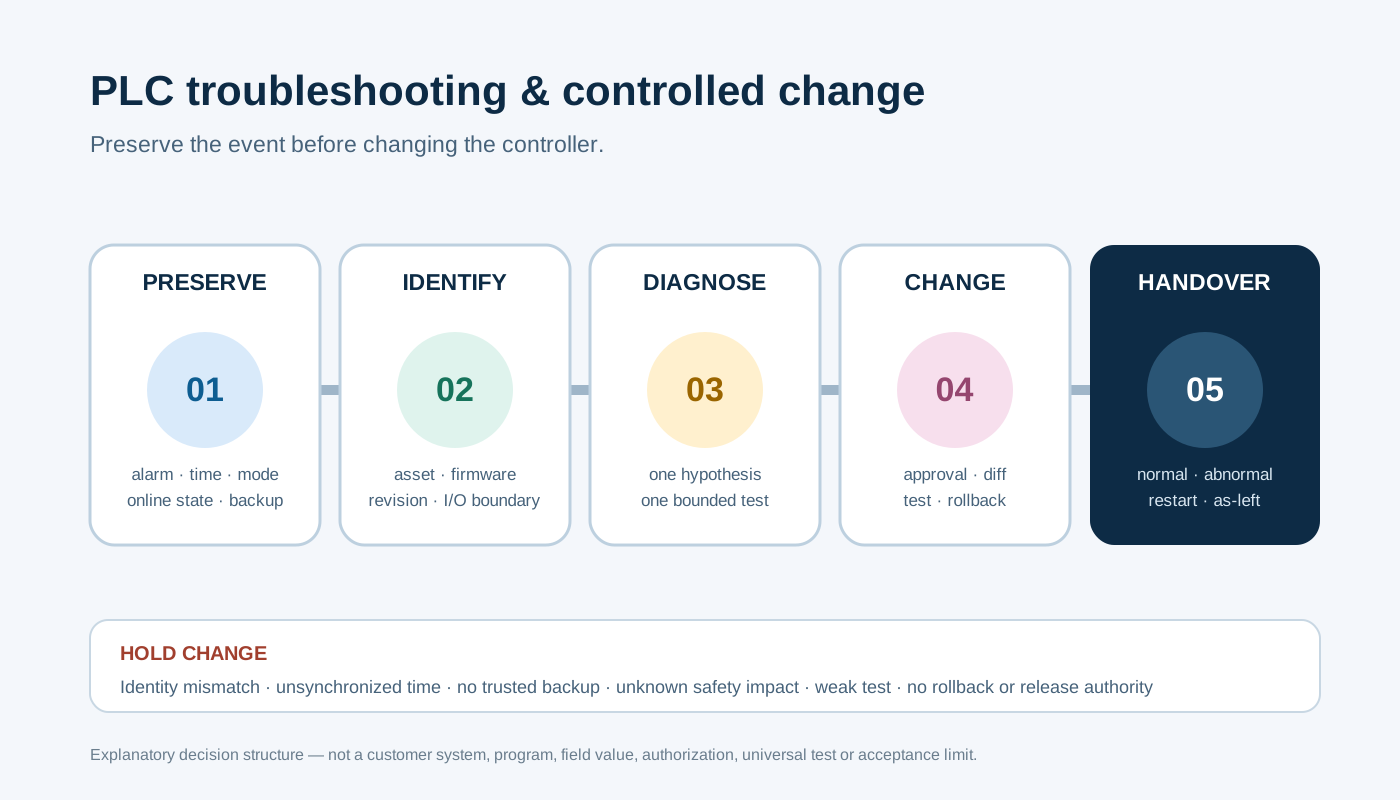
SYSTEM BOUNDARY
Six workstreams prevent a quick fix from becoming an undocumented change
Event and operating context
Symptom, first occurrence, exact alarm, controller mode, process phase, operator action, timestamps, recurrence and production impact.
Controller and program identity
Asset, model, firmware, project revision, checksum or hash, online/offline relationship, safety partition, I/O tree, network and time source.
Fault, task, I/O and communications
Major and minor faults, task execution, watchdog, I/O status, quality, connection state, diagnostics, power, wiring and physical response.
Hypothesis and bounded test
Logic, configuration, communications, field device, power, process and mechanical hypotheses separated by one controlled observation or test.
Approval, difference and rollback
Change owner, reason, affected routines and tags, online edits, safety impact, compare result, test plan, backup, rollback trigger and access record.
Validated as-left state
Normal, abnormal, loss-of-I/O and restart tests, final revision, open items, bypasses, backups, drawings, release authority and monitoring window.
EVIDENCE GATES
A program download is not a diagnosis, and a running machine is not an accepted change.
| Gate | Question to close | Minimum evidence | Named output |
|---|---|---|---|
| 0 · Incident preserved | What happened before any reset, edit or download? | Alarm text, timestamps, mode, process state, operator sequence, controller and module diagnostics, current online copy and protected backup | Incident evidence package |
| 1 · Identity reconciled | Are the field controller, engineering file and approved baseline the same intended system? | Model, firmware, revision, comparison, safety scope, I/O tree, communications, drawings, time source and ownership | Trusted diagnostic baseline |
| 2 · Diagnosis bounded | Which hypothesis does the next observation or test distinguish? | Expected and actual response, one variable, test state, hazards, stop point, data capture and reviewer | Evidence-backed cause disposition |
| 3 · Change authorized | What exact difference is approved and how is it reversed? | Change request, affected objects, compare report, backup, impact review, test plan, rollback trigger, access and named authority | Approved change package |
| 4 · As-left accepted | Does the complete system respond correctly in required states? | Normal, abnormal, restart, I/O-loss and communications tests; physical feedback; final compare; revision; restrictions; signatures | Validated as-left handover |
STOP CONDITIONS
Hold reset, edit, download or restart when the evidence boundary is weak.
Controller, firmware, project, checksum, I/O tree, network or approved baseline cannot be reconciled.
PLC, HMI, historian, drive, safety controller and operator records cannot form one defensible event order.
The current online state, approved baseline or recoverable rollback copy has not been captured and verified.
The change may affect interlocks, protective functions, permissives, restart inhibition, safe state or hazardous energy.
Expected response, field condition, one-variable rule, stop point, observer, data capture or rollback trigger is missing.
Change owner, test lead, operations, safety, cybersecurity or final production authority is unnamed.
PREPARE THE BOUNDARY
Start with a five-part PLC troubleshooting brief
- 01Freeze the incident.
Record exact alarms, mode, time, process phase, operator action, faults, I/O, communications and physical response before reset or edit.
- 02Reconcile identity.
Name controller, firmware, project revision, online/offline difference, safety boundary, I/O tree, networks, drawings and time source.
- 03Separate hypotheses.
Distinguish logic, configuration, network, field I/O, power, process and mechanical causes with one evidence-producing test at a time.
- 04Control any change.
Define affected objects, authority, compare, impact, test, backup, rollback trigger, access record and stop condition before implementation.
- 05Close the as-left state.
Preserve final revision, compare, normal and abnormal tests, restart behavior, open items, bypasses, restrictions, monitoring and signatures.
Confirm jurisdiction, site procedures, hazardous-energy controls, access authorization, cybersecurity program, OEM instructions, functional-safety responsibilities and accountable operating authority.
OFFICIAL PRIMARY SOURCES
Use standards, security guidance and vendor tools within their actual scope.
- IEC 61131-3:2025 — programmable-controller programming languages
- IEC 62443-2-1:2024 — IACS asset-owner security-program requirements
- NIST SP 800-82 Rev. 3 — U.S. guidance for OT security, reliability and safety context
- Rockwell Automation — Logix Designer Compare Tool User Manual
- OSHA 29 CFR 1910.147 — U.S. hazardous-energy control during servicing
IEC 61131-3 defines languages, not a universal troubleshooting method. IEC 62443 and NIST address IACS/OT security programs and safeguards. Rockwell material is product-specific. OSHA applies within U.S. jurisdiction and states that control-circuit devices are not energy-isolating devices. None supplies one universal scan-time, watchdog, fault-reset, online-edit or acceptance value.
RELATED FIELD RESOURCES